|
I'm a second-year undergraduate at MIT, pursuing a B.S. in Physics and Electrical Engineering with Computing. I am interested in training long-horizon agents to learn efficiently from demonstrations, and in the fast inference that makes them usable. As an ML Engineer at Alpaca Research, I contributed to the infrastructure for long-horizon autonomous research agents and computer-use agents. Additionally, I have done research in two MIT CSAIL labs, spanning reinforcement learning, computer vision, and robotics. In the CLEAR Lab, I built ALERT to streamline robot data collection for VLAs, and in the InfoLab, I built Clicke, a desktop agent that automates everyday computer tasks. Research Keywords: efficient inference, long-horizon agents, reinforcement learning, robot learning, learning from demonstration Skills: I work across the ML stack in Python, C/C++, Rust, and TypeScript, training and fine-tuning models with PyTorch, LoRA, and RL and serving them efficiently with vLLM and quantization on GPU clusters. On the robotics side, I have deployed policies on a Franka arm, fine-tuned models for a Unitree Go2 robot dog, and built an autonomous robot with embedded vision and motor control. I also ship full-stack and desktop apps with React, Node, and Tauri. |

|
 |
 |
 |
 |
 |
 |
|
|
|
|
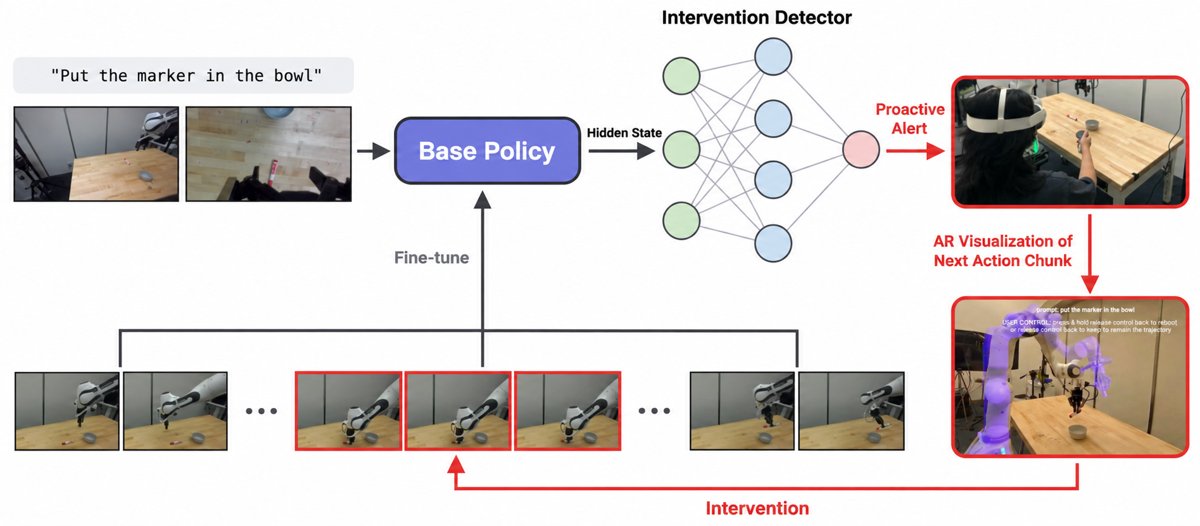
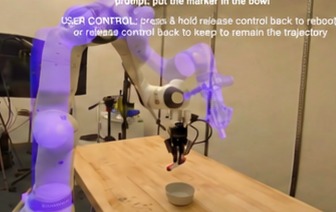
Jefferson Lin, Amanda Cheng, Jason Liu, Jonas Sun, Nick Walker CLEAR Lab, MIT CSAIL, 2026 system We introduce ALERT, a data-collection system in which the policy being fine-tuned drives the robot, a detector on its π0.5 hidden states warns the operator before a failure, and an AR headset previews its next actions. |
|
Jefferson Lin, Henry Lieberman InfoLab, MIT CSAIL, 2025–2026 Clicke is a local-first macOS agent that learns a task from one demonstration and replays it by re-finding each click target on the live screen. Fine-tuning Qwen3-VL-2B with LoRA plus a two-step zoom raised macOS ScreenSpot-Pro grounding accuracy from 30.6% to 61.8%. |
|
|
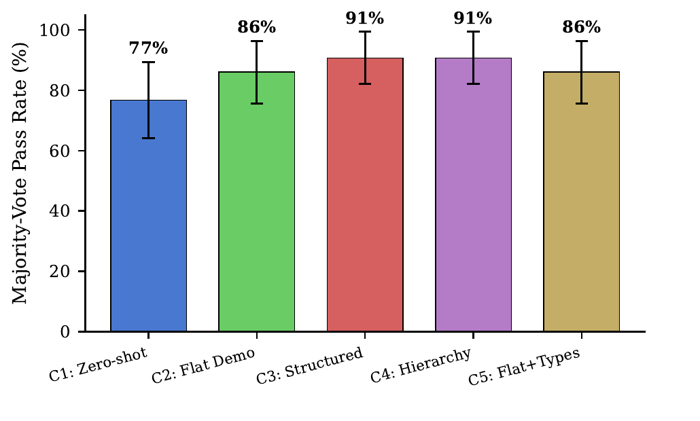
Jefferson Lin, Honjar Xing, Henry Lieberman ICML Workshop on Deep Learning for Code (DL4C), 2026 arxiv We introduce Agentic Goal Stacks, which organize a recorded demonstration into a hierarchy of named subgoals that an LLM agent can follow. On vaguely worded SlidesBench tasks, they raised the pass rate from 76.7% to 90.7%, compared with 86.0% for a flat action log, and ablations show that the subgoal grouping alone accounts for the gain. |
|
AI & Robotics Lab, Harvard, 2025–2026 code I built a LoRA fine-tuning pipeline that turns Qwen3-VL-2B into a navigation policy for the lab's Unitree Go2, mapping a camera image and an instruction to a discrete action. |
|
|
MIT MASLAB, 2026 code I coded the whole vision system for a fully autonomous can-sorting robot, a 7-class YOLOv8 detector fused with RealSense depth. |
|
|
Full-stack web app, 2025 website I developed a full-stack app for transactions, using React, Node/Express, Prisma, and Stripe. |